
Most of Us Say No – So WHY Aren’t We Saying So?
[TLDR: More than 90% of Singaporeans want the country to remain drug-free. But it can feel like the opposite is true in the online space. This article looks at how permissive drug views gain hegemony through the cultural lens for wider social issues, of legality, progressiveness, normalisation, curiosity and groupthink – and why knowing our capacity for influence might be the most important thing we bring to the table.]

The Gap Between What We Really Think and What Gets Said Out Loud
Here’s something that might surprise you: more than 90% of youths and adults in Singapore1 want our country to remain a drug-free society. That’s not a fringe view. That’s an overwhelming majority of the national population, and this sentiment has remained consistent across years of the survey.
So why does it so rarely feel that way online?
Permissive takes on drug abuse easily surface in Reddit threads, TikTok discussions, group chats and casual conversations with friends, and they tend to be loud, confident and framed as the normalised or reasonable position. Meanwhile, the majority view quietly goes unsaid. Not because people have changed their minds, but because speaking up can feel awkward, preachy or just not worth the friction and effort. However, the irony is that most of us actually want more honest and open conversations about drugs.
That gap is worth examining, because the silence of the majority inadvertently allows narratives that normalise drug abuse to go unchallenged and gain more weight than they deserve, misrepresenting it as the consensus or even common sense. With 50% of new drug offenders arrested in 2025 under 302, this is clearly not just background noise online but part of a wider risk that continues to affect young people.
That is where the attitude-behaviour gap, or value-action gap, shows up. We may genuinely believe in staying drug-free and keeping Singapore drug-free, but what we do in the moment does not always match what we think in principle. That does not necessarily mean people do not care. More often, it means managing ambivalence and holding two (potentially) conflicting attitudes in tension: wanting to stand for something, but also wanting to avoid imposing our views on others, or the feeling that one comment will not make much difference. Silence then gets rationalised as polite, low-risk or not worth the trouble, even when, deep down, we do think the conversation matters.
And that gap has its own drivers and barriers. People are more likely to speak up when the issue feels personal, when they feel clear about what they want to say, or when they believe their voice can still make a difference. But there are also familiar barriers: fear of sounding preachy, uncertainty about the right words, the assumption that someone else will step in, or the quiet hope that the moment will pass on its own. That is how the silent majority stays silent — not because the belief is missing, but because the step from belief to action can feel harder than it should.
Rethinking the Debate on Drug Legality and Acceptance in Singapore
Online chatter can make drug abuse sound like a simple debate about what is “normal” or “acceptable.” Some argue that Singapore should be more open-minded, especially as countries move towards greater acceptance and easier access to drugs, framing our position as draconian, backward and not progressive. Others say that Singapore’s stricter stance is exactly what keeps the country safe, stable and protected from the wider fallout that drug permissiveness can bring. That contrast is worth pausing on, because it is not just about opinions online — it is about the kind of everyday life Singapore chooses to protect.
That split is easy to see online, like Reddit.User sushiriceonly on r/askSingapore wrote:
“Lol, as a Singaporean who’s been living overseas for 7+ years and doesn’t plan to go back to SG to live ever again… I laugh. And draconian laws like this are partially why I don’t plan on going back.”
It reflects a broader pattern that the more exposure people have to environments where drug abuse is legal or normalised, the more Singapore’s stance can start to feel like the outlier. It is understandably human nature for curiosity about what one is “missing out on” to follow from there.
But others push back just as firmly. Noobcakes19 on r/askSingapore said:
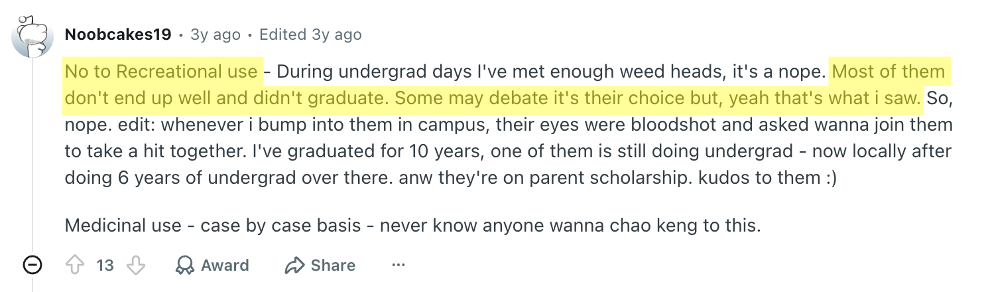
What comes through in that back-and-forth is not just disagreement, but a reminder of something many Singaporeans may not always stop to think about: the safety and security we move through every day is a privilege, not a given. Being able to walk safely anywhere, let children take public transport independently, or go about daily life without worrying about the social fallout of drug legalisation are things many of us may have come to take for granted.
That is why comments like sgboi1998 on r/askSingapore resonates:
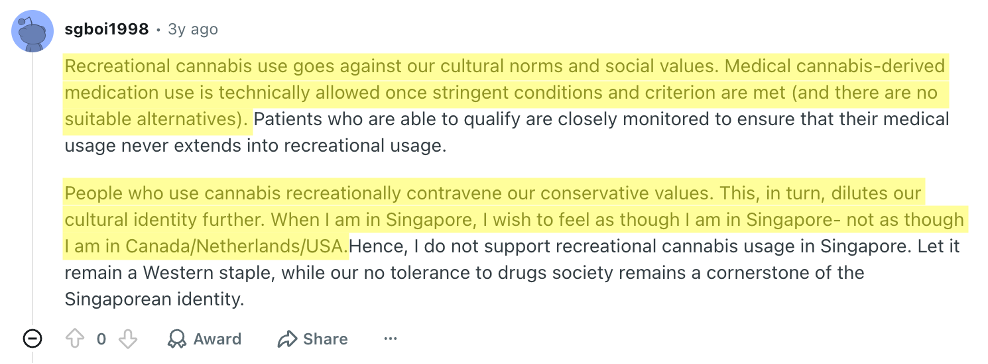
Singapore’s drug-free stance is, in fact, a values-based position that more than 90% of Singaporeans actually share, and not a failure to progress. And that is really the point. The countries most often held up as model examples of drug legalisation are still navigating significant social and economic costs, with communities dealing with the downstream effects of easier access. What gets called progress in one context can look very different when we examine the outcomes. Singapore’s drug laws are not just drawing a legal line, they protect the kind of everyday life that many other societies are still trying to get back.
That is why the gap matters. If the majority of us wish for our own society to stay drug-free, then the real issue is not whether the majority exists, but whether it shows up when the conversation gets uncomfortable. When the loudest voices online frame drug abuse as progress or the norm, silence can start to look like agreement. And over time, that is how a clear and deeper values-based position gets blurred into something that seems far more divided than it really is.
| Reference articles: 1 National Drug Perception Survey 2025 – National Council Against Drug Abuse 2CNB Annual Statistics Report 2025 – Central Narcotics Bureau |
You may also like

How Small Signs Get Missed
[TLDR: Drug abuse rarely starts with one big moment. More often, it grows through small choices, quiet shifts and warning signs that are easy to miss until things have already gone too far. In this interview-led feature, Peter Teo reflects on how earlier intervention, steady check-ins and speaking up sooner could have made a difference before drug […]

Most of Us Say No – So HOW Do We Actually Say So?
[TLDR: Most of us already know where we stand on drug abuse but that does not always make it easy to say so when the topic surfaces in casual conversations, especially with someone we care about. This article looks at how to hold your ground without shutting the person out, and why speaking up can […]